


Posted on Wednesday, 9th June 2010 by Eric Cressey

This past weekend, I had the privilege to experience Thomas Myers in seminar for the first time.  For those who aren’t familiar with Myers, he is the author of Anatomy Trains and a pioneer in the world of bodywork and fascial research.
at-2e-cover

There were a wide variety of attendees present, and Myers made dozens of interesting points - so the take-away message could easily have been different for everyone in attendance as they attempted to fit his perspective into their existing schemeta.

While I enjoyed all 150 minutes of his presentations, the portion of Myers’ talk that jumped out at me the most was his list of the eight means of improving “fascial fitness:”

1.       Use whole body movements

2.       Use long chain movements

3.       Use movements including a dynamic pre-stretch with proximal initiation

4.       Incorporate vector variation

5.       Use movements that incorporate elastic rebound - this consists of cylic motions of a certain speed (for instance, cycling wouldn’t count)

6.       Create a rich proprioceptive environment

7.       Incorporate pauses/rest to optimize hydration status

8.       Be persistent, but gentle (prominent changes can take 18-24 months)

A big overriding them of Myers’ lecture was that the role of the fascia - the entire extracellular matrix of the body - is remarkably overlooked when it comes to both posture and the development of pathology.  He remarked that he doesn’t feel like we have 600+ muscles in the body; he feels like we have one muscle in 600+ fascial pockets because they are so interdependent.  And, in this fascia, we have nine times as many sensory receptors as we’ve got in muscles.

Think about what that means when someone has rotator cuff problems - and treatment only consists of ice, stim, NSAIDs, and some foo-foo rotator cuff exercises.  Or, worse yet, they just have a surgical intervention.  It overlooks a big piece of the puzzle - or, I should say, the entire puzzle.

For me, though, these eight factors got me to thinking again about just how atrocious distance running is for pitchers.  I have already ripped on it in the past with my article A New Model for Training Between Starts, but this presentation really turned on a light bulb over my head to rekindle the fire.  Let’s examine these eight factors one-by-one:

1.       Use whole body movements - Distance running may involve require contribution from the entire body, but there is not a single joint in the body that goes through an appreciable range of motion.

2.       Use long chain movements - Pitching is a long chain movement.  Jumping is a long chain movement.  The only things that are “long” about distance running are the race distances and the length of the hip replacement rehabilitation process.

3.       Use movements including a dynamic pre-stretch with proximal initiation - This simply means that the muscles of the trunk and hips predominate in initiating the movement.  While the hips are certainly important in running, the fundamental issue is that there isn’t a dynamic pre-stretch.  This would be a dynamic pre-stretch with proximal initiation:

4.       Incorporate vector variation - A vector is anything that has both force and direction.  Manual therapists vary the force they apply to tissues and the directions in which they apply them.  There are obviously vectors present in exercise as well.  Here are 30,000 or so people, and pretty much just one vector for hours: forward (to really simplify things):
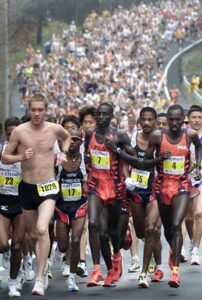
050413_waterrunning_vmed_2pwidec

Here is one guy (and a good looking one, at that) in multiple vectors in a matter of seconds:

Incorporating vector variation into programs is easy; it just takes more time and effort than just telling someone to “run poles.”  Take 8-10 exercises from our Assess and Correct DVD set and you’ve got a perfect circuit ready to roll.

Layout 1

5.       Use movements that incorporate elastic rebound - Sorry, folks, but even though the stretch-shortening cycle is involved with jogging, its contribution diminishes markedly as duration of exercise increases.  And, frankly, I have a hard time justifying bored pitchers running laps as “elasticity.”

6.       Create a rich proprioceptive environment - There is nothing proprioceptively rich about doing the same thing over and over again.  They call it pattern overload for a reason.  Pitchers get enough of that!

7.       Incorporate pauses/rest to optimize hydration status - Myers didn’t seem to have specific recommendations to make regarding work: rest ratios that are optimal for improving fascial fitness, but I have to think that something more “sporadic” in nature - whether we are talking sprinting, agility work, weight training, or dynamic flexibility circuits - would be more appropriate than a continuous modality like jogging.  This is true not just because of duration, but because of the increased vector variation potential I outlined earlier.

8.       Be persistent, but gentle - This one really hit home for me.  Significant fascial changes take 18-24 months to really set in. I am convinced that the overwhelming majority of injuries I see in mature pitchers are largely the result of mismanagement - whether it’s overuse, poor physical conditioning, or improper mechanics - at the youth levels.  Poor management takes time to reach the threshold needed to cause symptoms.  In other words, coaches who mismanage their players over the course of the few months or years they coach them may never actually appreciate the physical changes - positively or negatively - that are being set into action.

stressfracture

Distance running might seem fine in the short-term.  Overweight kids might drop some body fat, and it might make the practice plan easier to just have ‘em run.  Kids might not lose velocity, as they can compensate and throw harder with the upper extremity as their lower bodies get less and less powerful and flexible.

However, it’s my firm belief that having pitchers run distances not only impedes long-term development, but also directly increases injury risk.  Folks just don’t see it because they aren’t looking far enough ahead.


Please enter your email below to sign up for our FREE newsletter.

Name
Email

Tags: , , , , , , , , , , , ,
Posted in Blog | Comments (15)

15 Responses to “The Fascial Knock on Distance Running for Pitchers”

  1. Rick Kaselj Says:

    Excellent to hear someone like never stops going to seminars and reading books.

    An important message to all of us.

    Rick Kaselj

    .

  2. Matt Biancuzzo Says:

    Eric,
    Wish I could’ve gone to listen to Myers talk. It’s awesome to get a some cliff notes of his lecture, so thanks for that. I definitely recommend Anatomy Trains to all practitioners that I work with. Great read and tons of valuable information. My question for you is, did Myers discuss any specific modalities that he saw better improvement in fascial restrictions? Graston, ART, etc? Or has that area yet to be researched by him?

  3. Forrest Says:

    I agree that dynamic movements and multi-joint exercises are essential to developing an explosive body that is also built to handle that “explosiveness.” I also agree that running is boring and can be tough on the joints. However, as a former professional pitcher, I don’t feel there is any replacement for cardio for an extended period of time after a long pitching outing. This doesn’t have to be running, but over the course of a long season, that does tend to be the most accessible exercise for a pitcher at a ball field. If they have a bike, or better yet, a row machine, or an elliptical, or (less likely) a swimming pool, any of these would be great for getting the heart rate up and the blood flowing for an extended period of time. I suppose a circuit of multiple exercises as alluded to in the article would also be an option. Either way, I enjoyed the notes on presentation.

  4. Julie Keen Says:

    Excellent Eric! Thomas’ presentation was fantastic and I can’t stop thinking about it.

  5. James Says:

    Eric,
    In a T-Nation posting you had listed Born to Run as one of the best books you read last year. Considering the ample empirical evidence the author provides that humans evolved as the greatest long-distance running organism on the planet, how do you draw the conclusion that running is a sure path to hip replacement and chronic injuries? Of course, if you assume bad form, bad programming and bad shoes than I can heartily agree. Also, I would certainly agree that long distance running is not the most efficient means of pitcher training.
    Love the continued expertise and insight, please keep it up!

  6. Ron Says:

    Forrest,
    I hear this almost every single week from coaches at every level…from Select Travel to MLB.

    “However, as a former professional pitcher, I don’t feel there is any replacement for cardio for an extended period of time after a long pitching outing. This doesn’t have to be running, but over the course of a long season, that does tend to be the most accessible exercise for a pitcher at a ball field.”

    Trust me Forrest…the replacements are ONLY limited to your imagination. 99% of those I run across are stuck…not by a lack of any viable replacement’ but stuck on a bad and ill advised tradition and the embarrassment of sticking out and going against conventional wisdom.

    What must change is your paradigm and your understanding of what ‘cardio’ means as it relates to the pitching/baseball athlete. Since you are here at EC’s you have come 90% of the way. Now its time for you to go ALL the way. Start by studying in detail…EC’s article A New Model for Training Between Starts

    Welcome to the light Forrest. You’ll love it herr.
    Besty of luck my man. We need you in baseball.

    EC…hope ALL is well. I don’t get to visit much as I’m super busy in summer…but I miss you man.
    Had 5 of our guys go yesterday.

    Ron Wolforth

  7. Ryan Says:

    That was great Eric! Thanks for sharing Thomas’ points as well as your spin on it by using the long distance running example. I am constantly seeing long distance running used as warm ups for young athletes, running your two laps, as well as conditioning for sports such as soccer and football. It doesn’t make sense for these guys to do that and when you look at it from a fascial standpoint it further solidfies the point.

    Love all the great stuff your putting out there! I would have like to see you speak at PB Providence but am making it to the Long Beach one where it doesn’t look like you will be presenting. Hopefully another time.

    All the Best,
    Ryan Christie

  8. Alex Katsanos Says:

    Thanks for the post Eric. Mr. Myers also teaches a course for Yoga teachers that I hope I can take someday. You can see the different trains working quite clearly in yoga poses for example forward bends.

    This is an exciting time for fascial research. We are just starting to figure out all the things the fascia does. They have an international congress every year just on the subject where people doing research on it come to present their ideas. They think it also has to do with neuropeptide signaling which allows acupuncture to be so effective.
    Alex K

  9. Dan Kopitzke Says:

    Eric,
    Excellent as always. Never hurts to get more information in support of a different, better way to train baseball players. What I like about this information is that it falls right in line with Ron Wolforth’s number 1 principal - “Do no harm”. Some coaches may understand that running poles doesn’t help their players, but they do it anyway because they don’t think it will hurt them. Well, here’s information that says that it will…

  10. Nick Chertock Says:

    I think facia and the nervous system are the next big ideas in fitness that are totally underexplored. There will be those certain guys in the gym who will say that fascia is a made term which will be funny but simultaneously sad.

    I ran cross country for a few years in high school and I am convinced that it did long term damage to my body. Not that running is bad, but rather THE WAY I WAS RUNNING was beyond bad. Most pitchers as well don’t show the running prowess of the Tarahumara. The Army is starting to move away from forced distance runs in their which has caused a lot of controversy.

  11. Luka Hocevar Says:

    Eric,
    great information!

    I like the way you explained the 8 points as I’ll be able to use a couple as we spend some time with kids and their parent’s/coaches from a local soccer team that is pushing the long distance running.

    Also shows me I need to dive back into Anatomy Trains a little bit :)

    Luka Hocevar

  12. Ken Says:

    Saw this in Connelly’s Top 10 Boston Herald online (6/11/10 edition) about high school pitchers:

    2. High School Baseball Coaches Gone Wild - This week in the Massachusetts MANY coaches allowed their teenage pitcher throw in excess of 135 pitches in a game - how about some examples of crazed if not almost criminal coaches that should be fired for selfish and dangerous coaching this week:

    * Owasso, Oklahoma - Dylan Bundy threw 112 pitches and then came back in game 2 (two hours later) and threw another 69 pitches for 181 on the afternoon (three days earlier he threw 112 giving him 293 in four days)
    * Two years ago Dylan’s brother Bobby threw 163 pitches in 13 innings for the same coach
    * West York Pa - 16 year old Kaden Helper threw 150 pitches (17 K)
    * Woodbridge Virginia - Nick Rogowski threw 141 pitches / earlier in the season he threw 153

    This is very disturbing!!

  13. Rees Says:

    Great newsletter. Thanks.
    I’m really liking your shoulder DVD set as well. Really good stuff. Well worth the buy.

  14. Carson Boddicker Says:

    Eric,

    Nice thoughts, and I appreciate your comments. I have a few thoughts/questions that ideally somebody may be able to clear for me.

    1. What magnitude of dynamic pre-stretch satisfies Myer’s requirement?

    2. What magnitude of proximal initiation matters? In looking at the spinal engine (if Gracovetsky is on point), that is proximal initiation to an extent?

    3. Regarding the proprioceptive environment requirements, can we hedge our risks by running over “natural” terrains where stance phases are by no means mechanically identical?

    Thoughts, all?

    Regards,
    Carson Boddicker

  15. jamie douse Says:

    Eric
    I like the points you make regarding being persistent but gentle. I work with elite level Australian Football youth players and i get pretty pissed off with the coaches of these kids who have absolutely no idea about long term athlete development and try and implement programs they see elite level senior athletes performing.

Leave a Reply