




Eating at Night: An Insult to Health or a Harmless Practice?
Anyone who has followed me for a reasonable length of time will know that I’m a huge fan of the great people and work at Examine. Thousands of nutrition and supplement studies are published every month, and Examine makes it easy to stay on top of what matters by interpreting the latest research and efficiently explaining what it actually shows.
With that in mind, I reached out to them to see if they’d be up for sharing a sample of the great information available at Examine. As such, below is one of Examine’s Study Summaries, unedited and republished with full permission.
Before we begin, it’s important to note that Examine does not use generative AI to write or analyze research content. Their team of researchers is responsible for interpreting and contextualizing the studies it covers. ExamineAI is the only AI tool on the site, and it summarizes Examine’s existing human-written content rather than generating new research analysis.
Our take
Eating at night is bad for you… right? Although observational evidence suggests that this is the case, the evidence from randomized controlled trials doesn’t paint a clear picture. In this crossover trial in young women, eating a late dinner did not clearly affect glycemic control, compared to an earlier dinner, but it did worsen both sleep quality and quantity. However, other studies don’t indicate that eating closer to bedtime negatively affects sleep, so for now, an individualized approach is probably best.
Study type
Randomized crossover trial
Population
13 young women (average age of 21; average BMI of 21) who were enrolled at Tokyo University of Technology and did not have diagnosed health conditions
Intervention
For 4 days, the participants ate a standardized dinner (about 700 calories) either 1 hour or 5 hours before bedtime. Sleep was measured using electroencephalography (the gold-standard method). The participants wore a continuous glucose monitor throughout the study, and they completed an oral glucose tolerance test the day after each condition.
Notable results
Compared to the early dinner, late dinner decreased sleep duration (−33 minutes), decreased sleep efficiency, and increased sleep disturbances.
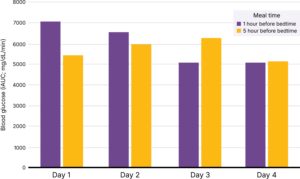
Postprandial glucose levels in the 3 hours after dinner and glucose levels after the oral glucose tolerance test did not clearly differ between conditions.
Blood glucose levels after dinner
The big picture
There’s a lot of interest in the health effects of eating at night. This interest primarily stems from evidence from observational studies, which indicates that eating later at night is associated with an increased risk of obesity and worse cardiometabolic health.[PMID: 28137935] [PMID: 39064774] One hypothesis is that this is the result of circadian misalignment,[PMID: 32662577] which broadly means eating at a time of day that is out of sync with circadian rhythms or the body’s natural clock.
The circadian timing system is composed of a master clock in the brain (i.e., the suprachiasmatic nucleus in the hypothalamus) and peripheral clocks all throughout the body.[PMID: 33222161] Virtually all biological processes are controlled by the circadian timing system through a daily cycle of circadian rhythms, periodic patterns that repeat themselves approximately every 24 hours.[PMID: 29195759]
Accordingly, there are ebbs and flows in biological processes throughout the day. For example, melatonin levels decline over the first couple of hours after awakening and are low during the day, but the body starts ramping up melatonin production a few hours before bedtime to induce sleep. Similarly, glycemic control tends to deteriorate over the course of the day.[PMID: 29195759]
It’s thought that the master clock and the peripheral clocks need to be in alignment for optimal health.[PMID: 24892891] However, the timing of these clocks can get out of sync because they’re influenced by different external factors called zeitgebers.
The master clock is regulated by light exposure, whereas food intake is the major zeitgeber for peripheral clocks.[PMID: 32662577] A common scenario in which circadian misalignment can arise is waking up early and eating late at night; early light exposure shifts the schedule of the master clock forward, whereas the timing of food intake shifts the schedule of the peripheral clocks later.
Circadian alignment vs. circadian misalignment
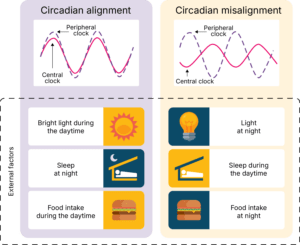
Adapted from Poggiogalle et al., 2018, Metabolism
One key mechanism by which this skewed schedule could impair metabolic health pertains to melatonin. The time at which melatonin production ramps up is an indicator of the master clock’s schedule.[PMID: 18350967] Shifting meal times to later in the day does not affect the timing of melatonin production.[PMID: 28697366]
This is a potential problem because evidence suggests that eating in the context of elevated melatonin levels leads to higher postprandial glucose levels.[PMID: 31901302] Consequently, consistently having meals in the context of elevated melatonin levels (which would hypothetically occur in the context of circadian misalignment) could increase type 2 diabetes risk.[PMID: 31901302]
Considering this information, there are 2 main questions to address as to whether eating at night is particularly detrimental to metabolic health: (i) Does eating at a time that is out of alignment with the master clock impair glycemic control? (ii) Does eating late at night, even if the master clock and peripheral clocks are aligned, result in worse glycemic control?
The summarized study provided insight into question number one. The time between the participants’ usual dinner time and bedtime was about 4 hours, so the early dinner was more or less aligned with their circadian rhythms, whereas the late dinner was a meaningful deviation.
Although overall glycemic control did not differ between conditions, there was some variation from day to day. The measurements suggested that blood glucose levels after dinner were higher with the late dinner than the early dinner on day 1, but not on days 3 and 4. Furthermore, in the late dinner condition, postprandial blood glucose levels were lower on days 3 and 4 than day 1. This evidence suggests that the peripheral clocks adapted to the new schedule, resulting in the maintenance of glycemic control.
In a similar 2-day randomized crossover trial that had young men stay in a laboratory, delaying the timing of all meals by 3.5 hours negatively affected glycemic control.[PMID: 36858920] The participants went to bed at 12 p.m. and woke up at 8 a.m., so the late meal schedule resulted in dinner occurring 1 hour before bedtime, compared to 4.5 hours before bedtime during the early schedule.
Additionally, the average 24-hour blood glucose level was higher during the late schedule (approximately 99 vs. 91 mg/dL), which was mainly due to higher blood glucose levels while sleeping.[PMID: 36858920] However, similar to the summarized study, postprandial blood glucose levels within a couple of hours after dinner did not differ between conditions.
A couple of differences between this study and the summarized study make the results difficult to compare. For starters, this study didn’t evaluate whether the average 24-hour glucose level differed between days 1 and 2. It’s possible that (like the summarized study) it was the worsened glycemic control on day 1 that drove the results. Also, the summarized study didn’t measure glucose levels over 24 hours, so it’s unclear whether there was a negative effect on this outcome.
There is one relevant longer-term randomized controlled trial that provides the best evidence to date on this topic. In this 8-week randomized crossover trial, the participants maintained their usual sleep and wake times (around 11:45 p.m. and 8 a.m.) and ate between 8 a.m. and 7 p.m. or between 12 p.m. and 11 p.m.[PMID: 33259790] HOMA-IR was lower with the earlier eating schedule than the late eating schedule.[PMID: 33259790] Whether this was a genuine difference is unclear, however, because the participants lost weight on the earlier eating schedule, and blood was collected after a longer period of fasting on the earlier schedule, both of which could have influenced the results.
Overall, it remains to be determined whether eating at times that are not perfectly in sync with the master clock negatively affects glycemic control over the long term. At the very least, it seems that the potential magnitude of effect is relatively small, which means that if you’re concerned with metabolic health, prioritize factors like eating an overall healthy diet, regularly exercising, and maintaining a healthy body weight, all of which are more important than meal timing.
Moving on to question number 2, there isn’t much evidence from randomized controlled trials that being a natural night owl harms metabolic health. In a rigorously controlled trial that had participants stay in a laboratory, delaying both meal times and sleep and wake times by 5 hours initially led to higher total daily postprandial blood glucose levels, but after a couple of days on this later schedule, postprandial blood glucose levels did not clearly differ from the ones from the participants’ earlier schedule at baseline.[PMID: 39620138]
Moreover, the return of postprandial glucose levels to within the participants’ usual range coincided with a delay in the onset of melatonin production by a couple of hours, which provides clear evidence of a biological adaptation to the new schedule.[PMID: 39620138]
In further support of the idea that eating later in the day or at night is not always worse for glycemic control, a randomized crossover trial, which had participants with a morning chronotype or an evening chronotype consume standardized meals at 7 a.m. or 8 p.m., reported that postprandial blood glucose levels did not differ between times of day in the evening chronotype participants, although glucose levels were higher in the morning chronotype participants when the meal was eaten in the evening.[PMID: 38605233]
Collectively, these sources of evidence suggest that circadian rhythms shift in accordance with behaviors to maintain homeostasis. So if your preferences and schedule call for going to bed later, waking up later, and eating more at night, don’t worry about these habits ruining your metabolic health.
Besides potentially affecting glycemic control, another concern about eating at night is that it could impair sleep. A common sleep hygiene recommendation is to have the last meal of the day at least 2 to 3 hours before bedtime.[PMID: 38761649] This recommendation aligns with the findings of the summarized study — eating 1 hour before bedtime impaired sleep — but other trials that have evaluated the effect of meal timing on sleep have not found that eating closer to bedtime impairs sleep.[PMID: 36410338][PMID: 32525525][PMID: 29332677][PMID: 28578930][PMID: 33259790]
Want to keep up with the research without reading thousands of studies yourself?
Examine+ helps you stay current on new research, dig into the evidence on supplements and health topics, and get clearer answers without doing all the searching and interpreting yourself. Try it free for 7 days.
If you work with clients or patients, Examine Clinician Edition includes everything in Examine+, plus the Supplement Navigator for evaluating evidence, reviewing dosing and safety considerations, and turning your findings into client-ready protocols and handouts. Try it free for 14 days.
Archives: