




Why Jump Height Doesn’t Tell the Whole Story: Tracking Weight, Momentum, and Velocity
Today, I’ve got a guest post from Cressey Sports Performance – Florida strength and conditioning coach and Sports Science Coordinator, Yassir Kahook.
In baseball, offseason development is about more than chasing flashy metrics. Jump height is often overvalued, especially for athletes whose primary goal is to gain weight. When we add mass to an athlete, the number on the scale alone doesn’t tell us whether that weight is functional, slowing them down, or simply adding load they now have to manage.
That’s why we track body weight alongside jump momentum and peak velocity on our force plates. Together, these metrics give a clearer picture of performance and adaptation.
Jump Momentum: Seeing How Weight Gains Translate
Jump momentum (calculated as body mass multiplied by takeoff velocity) becomes particularly important during weight gain phases. If body weight increases and jump momentum rises along with it, this suggests the athlete isn’t just heavier; they’re capable of producing force quickly enough to move that mass. In other words, the weight is functional. We see strong correlations between jump momentum and exit velocities for hitters, and ball speed for golf drives.
Conversely, if takeoff velocity drops while body weight increases, it may indicate that the added mass is starting to slow the athlete down. That doesn’t automatically mean the weight gain is bad – but it signals that training, nutrition, or recovery strategies may need adjustment.
Why Peak (and takeoff) Velocity Matters
Peak velocity provides insight into how explosiveness is being maintained. If an athlete can keep – or even improve – peak velocity while gaining mass, it’s a strong sign that adaptations are positive. We’re not chasing a higher number on a scale; we’re ensuring that increased mass enhances force production and movement efficiency.
Expect the Ups and Downs
During the offseason, performance will naturally fluctuate; there will be hills and valleys. This isn’t a sign of failure; it’s a reflection of intentional programming. We purposely push athletes into periods of fatigue to stimulate adaptation. These “stress blocks” are necessary for long-term gains, but they temporarily reduce performance. What matters is not every dip in a graph, but how large the drop-offs are and how quickly the athlete recovers.

The most critical data point is the final measurement of the offseason. This snapshot tells us whether the athlete is peaking at the right time. If managed correctly, these peaks coincide with the athlete entering the preseason ready to perform at a high level. Interestingly, even after the offseason ends, many athletes continue to improve during the first few weeks of the season, benefiting from the foundation built during their structured offseason work.
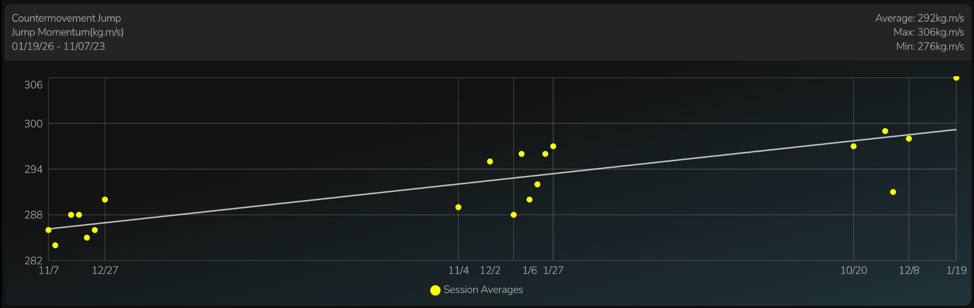
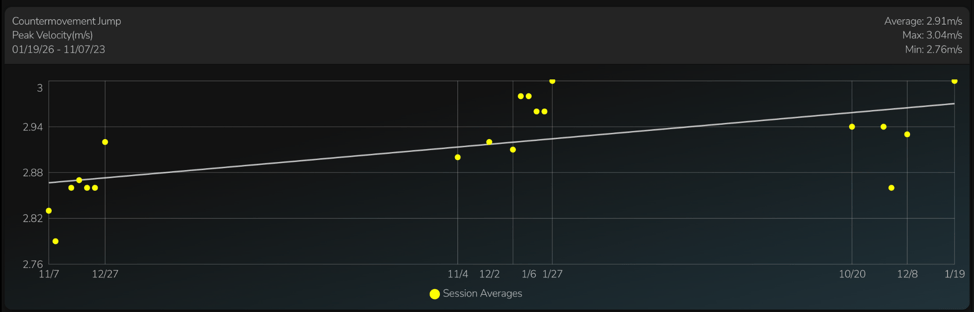
To illustrate, consider one of our professional athletes’ trends from the past few years:
- Body Weight: Stayed relatively stable, showing that the athlete maintained functional mass rather than chasing unnecessary weight gain. This stability allows us to attribute improvements in other metrics to strength, power, and efficiency, rather than simply added mass.

- Jump Momentum and Peak Velocity: Both increased consistently year over year. Jump momentum reflects the athlete’s ability to produce force efficiently. Peak velocity trends confirm that the athlete is maintaining or improving explosiveness while handling their current mass. Together, these metrics provide a nuanced view of physical development beyond what jump height alone can tell us.
- Average Pitch Velocity: Over this same period, the athlete’s average pitch velocity progressed steadily from 92.4 mph in 2023 → 93.4 mph in 2024 → 95.2 mph in 2025 → 96.1 mph thus far in 2026. Importantly, these gains occurred without injury, highlighting the success of carefully monitored progression.
By looking at these metrics together, we can see how the athlete adapts to training stress over time:
- Temporary dips are expected; they indicate that the athlete is being challenged.
- Consistent upward trends in jump momentum and peak velocity show that the athlete is recovering well and building functional capacity.
- Stability (or slight increase) in body weight while momentum and velocity steadily increase confirms that performance gains are not just from added mass, but from improved efficiency and power production.
In short, tracking jump momentum, peak velocity, and body weight gives us a complete picture of an athlete’s development. Rather than chasing arbitrary metrics like jump height alone, we can measure true functional progress, ensure athletes peak at the right time, and reduce the risk of overtraining or injury.
Tracking the Right Questions
By monitoring body weight, jump momentum, and peak velocity together, we can answer questions that matter most:
- Is the athlete gaining weight they can actually use?
- Are they maintaining explosiveness as mass increases?
- Is performance trending upward, or are we accumulating fatigue?
The goal isn’t bigger numbers on the scale or higher jumps for their own sake. It’s intentional, measurable, performance-driven growth. These metrics ensure that every pound gained translates into improved force production and movement quality.
About the Author
Yassir Kahook serves as a Strength and Conditioning Coach and Sports Science Coordinator at CSP-FL. He completed an internship at CSP-FL in the Summer of 2023, and returned as a seasonal coach in the winter of 2023-24. Yassir played Division 1 collegiate baseball as a pitcher at the University of Akron, where he earned a BS in Exercise Science. He also played one year at the University of Toledo. He has previous experience working at Activ Physical Therapy in Ridgefield, Ohio, and also volunteered as a student-assistant in the athletic training room during his college experience. A CSP athlete during his college career, Yassir recognized the carryover his training had to on-field health and performance, so he’s excited to share his knowledge and experience with the next generation of CSP athletes.
Archives: