


Grip Strength: One Simple Test, Every Population
Today’s guest post comes from Cressey Sports Performance – Florida strength and conditioning coach and hitting analyst, Ben Cashman.

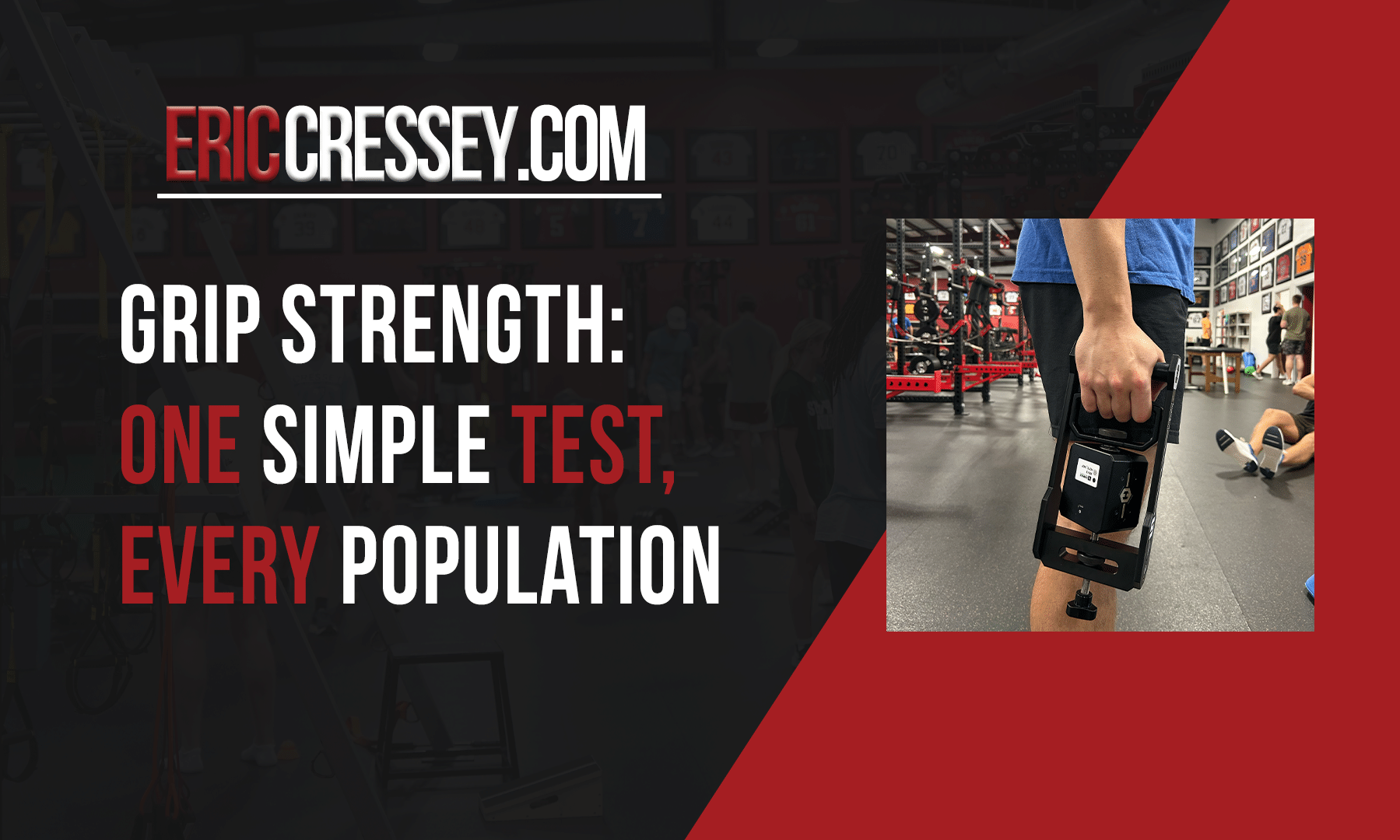
Grip strength takes about a minute to set up and complete, needs one dynamometer, and can be repeated often without adding meaningful fatigue or injury risk. Analyzing the underlying metrics and the force-time curve tells a deeper story about individuals across all populations.
What We Measure
Peak net force is the highest force an athlete produces above baseline. It measures maximal force output and works best as a long-term marker of upper extremity strength.
Average net force reflects how well an athlete sustains output across the test window. Two athletes can share the same peak but have very different averages.
Peak RFD is how quickly force rises – or the steepest slope on the curve. It reflects how fast an athlete can express force and is often used to measure fatigue and neural drive. Two athletes can achieve identical peak net forces, but use different strategies based on high or low RFD.
3-Second vs. 8-10 Second Isometrics
A 3-second test captures peak force and RFD cleanly. It’s quick and low-fatigue, and ideal for pre-session and weekly monitoring. However, three seconds is often too short for a fall-off to appear.
An 8-10 second test adds force maintenance. Peak force may look the same, but the curve can differ: one athlete holds a plateau, while another fades at four or five seconds. A 3-second test scores them the same, but longer duration provides deeper insights.

Youth Athletes
For young athletes, grip strength is a simple long-term marker of upper-body strength and development. The test is easy to administer and requires very little technical ability, which suits athletes new to training. Retest every few months, focus on peak net force, and observe the trend as they grow.
High School and College
Across high-stress and low-stress throwing periods, as we manipulate velocity work and throwing volume, track grip metrics against an established baseline. A persistent drop in peak force, average force, or peak RFD suggests an under-recovered athlete, reflecting neuromuscular fatigue that’s hard to see from the outside. Often RFD dips first, then peak force follows if the load continues, which can prompt a coach to integrate a deload period. Rebounding values in low-stress phases suggest recovery is working. Pair these metrics with velocity, workload, and athlete-reported wellness for a well-rounded approach to monitoring workload.
Professional Athletes
Here, more frequent tests looking for small changes in force-time curves and underlying metrics matter more than long-term growth. In addition to the outline above, look at asymmetry between hands across every metric. A modest throwing-side advantage is normal, but a large gap, or a throwing-hand decline relative to the other side, could deserve investigation.
Older Adults
Large population studies link lower grip strength to higher mortality, cardiovascular disease, and functional decline. It’s likely a proxy for overall strength and health rather than a cause of longevity, but as a screening tool, it’s quick, cheap, and easy to repeat annually.
Peak force (how strong?), RFD (how fast?), and the longer hold (how well is force sustained?) all matter here.
Wrap-up
As you can see, a simple grip strength test can yield a lot of important information. Just remember, though, that this doesn’t mean that overhauling training programs to specifically target grip strength is warranted. Rather, you’re looking at it like routine regular bloodwork; good habits elsewhere (training) should deliver favorable results, and aberrant findings tell us we may need to add or subtract something else from the training equation.
About the Author
Ben Cashman joined the team as a strength and conditioning coach and hitting analyst after completing two internships at CSP-FL in the Spring and Summer of 2026. Originally from Hingham, MA, Ben earned a B.S. in Applied Exercise with a concentration in Strength and Conditioning from Springfield College. He has experience working with athletes across all levels in both collegiate and private settings, where he developed a strong interest in using data and technology to enhance athletic performance.
Archives: