




Force Plate Trends in Youth Athletes
Today’s guest post comes from CSP-FL Sports Science Coordinator and Strength and Conditioning Coach, Yassir Kahook.

Force plates can be a game changer for youth athlete development. While they offer coaches an enormous amount of information – from jump momentum and peak velocity to braking characteristics and force-time curve shape – the real value for youth athletes may come from using the technology to keep things simple.
Youth athletes do not necessarily need to understand every metric a force plate can provide. In fact, overwhelming a young athlete with data can take away from what matters most: learning how to train, developing movement skills, getting stronger, and building a foundation for long-term athletic development. Instead, force plates can provide coaches with a simple and objective way to track whether that foundation is actually being built.
One of the biggest advantages of using force plates with youth athletes is the ability to track development over time. A single test tells us very little about an athlete’s long-term trajectory. However, testing the same athlete consistently over one, two, or even several years can tell a much more meaningful story. We can see how strength and power develop as the athlete grows, matures, and accumulates training experience.
When an athlete sees their jump performance, force production, or other key metrics improve over months and years, they have tangible evidence that their consistent training is producing results. That data can create buy-in from the athlete while also giving coaches and parents a clearer picture of development.
The goal should not be to turn youth athletes into data scientists. It should be to use technology to simplify the story of development. A few meaningful metrics, tracked consistently, can answer some of the most important questions: Are they getting stronger? Are they becoming more powerful? Are they improving their ability to produce force? Most importantly, are they continuing to show up and train consistently?
This athlete is a prime example of all of this. Over nearly three years of consistent training, both system weight and jump height have shown essentially linear progress. But the most impressive part of the data isn’t necessarily the rate of improvement—it’s the consistency behind it.

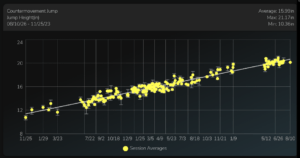
There are almost no gaps in the data (other than High School baseball season), meaning this athlete consistently showed up, trained, and was tested over a long period of time. That level of consistency gives us something extremely valuable: context.
This is one of the things that can be extrapolated from force plate data that often gets overlooked. Force plates aren’t just useful for identifying changes from one test to the next. When collected consistently over months and years, they can tell a much bigger story about an athlete’s development, training consistency, and long-term trajectory.
That is where force plates can truly become a game changer. They do not replace good coaching, thoughtful programming, or years of consistent training. Instead, they give coaches a way to quantify the results of those things.
For youth athletes, sports science does not have to mean more complexity. Sometimes, its greatest value is proving that simple, consistent training over time works.
Further Reading/Listening
If you’re looking to learn a bit more about how we use force plates, two suggestions:
1. Check out this previous article: Why Jump Height Doesn’t Tell The Whole Story: Tracking Weight, Momentum, And Velocity
2. Give our podcast with Hawkin Dynamics Vice President of Performance Drake Berberet a listen:
Archives: